Autonomous 'Fraud Agents': What Happens When AI Can Run an Entire Attack Without a Human Operator

.jpg)
The digital threat landscape has reached a turning point where AI no longer just assists criminals but actively directs them. We are entering the era of self-operating fraud systems: software capable of planning and executing complex scams from start to finish without a human operator.
Can AI Already Run a Fraud Attack Without a Human?
For decades, the human bottleneck limited cybercrime. Fraudsters had to research targets, craft messages, and manage conversations manually. In 2026, that requirement has largely disappeared, and the evidence is already there.
In September 2025, Anthropic detected the first documented large-scale AI-led cyber espionage campaign, in which AI handled 80–90% of the operation across 30 organisations with minimal human input. Separately, Group-IB's High-Tech Crime Trends Report 2026 documents AI-powered scam call centres already running fraud operations across multiple channels simultaneously, combining synthetic voices with LLM-driven coaching. What began as experimental is becoming standard.
Sumsub's Identity Fraud Report 2025-2026 captured the first confirmed appearances of these systems in 2025, describing them as "autonomous systems that combine generative content, scripting, and behavioural mimicry to execute full verification attempts end-to-end."
What began as experimental is expected to become standard across criminal networks by mid-2026.
Real-World Impact of AI-Driven Fraud in 2026
Automated fraud is no longer theoretical. It is showing up in record-breaking loss statistics.
The Cifas Fraudscape 2026 report, drawing on data from the National Fraud Database, recorded 444,993 fraud cases in 2025: the highest volume ever filed. Identity fraud was the most common type, accounting for 54% of all cases, with over 242,000 incidents recorded.
The UK Government's Fraud Strategy 2026–2029 sets out the wider scale. Fraud now accounts for an estimated 45% of all crime in England and Wales, with around 1 in 14 adults a victim in the year ending September 2025. The economic cost reaches at least £14.4 billion annually.
Is Traditional Fraud Detection Failing?
Most security systems were designed to focus on detection or stop attackers from breaking into software: scanning for suspicious code, unexpected network behaviour, or known malware signatures. Modern AI-driven fraud does not work that way.
Scammers now operate through the same platforms organisations use every day, including email, video calls, and file-sharing services. They do not need to exploit a technical vulnerability if they can construct a convincing enough reason for a legitimate user to act.
The Microsoft Digital Defense Report 2025 confirms this shift directly: "Adversaries are leveraging emerging technologies to attack with both greater volume and more precision than ever before, often by exploiting the trust that underpins our digital lives. The UK Government's Fraud Strategy 2026–2029 identifies the same pattern, noting that fraud now primarily exploits human trust rather than technical weaknesses.
Scenario: The Infinite Call Centre
Picture a self-operating AI system targeting accounts departments across the UK, running like a call centre that never needs a break and gets better at its job with every interaction.
Preparation. The AI scans public filings, press releases, and LinkedIn pages. It identifies the Finance Director by name and role, finds a recording from a virtual industry event, and notes an ongoing project from the company's newsroom.
The hook. Using the recording, the AI clones the Director's voice and calls a junior member of the finance team, referencing the specific project to establish instant credibility.
The pressure. The cloned voice explains there is an urgent invoice that needs processing today. A new supplier must be paid before the close of business. The request is framed as routine.
The reinforcement. A perfectly formatted invoice arrives in the employee's inbox as the call continues. It matches the verbal request exactly.
The result. The employee authorises the payment. By the time the fraud is discovered, the same AI has run an identical process across a dozen other companies that morning.
What This Means for Businesses and Individuals
The broad availability of AI tools means that high-precision deception is no longer the exclusive territory of sophisticated criminal groups. Fraud-as-a-service platforms have lowered the barrier so far that running a convincing impersonation attack no longer requires skill, resources, or experience.
The Cifas Fraudscape 2026 report notes that 4 in 5 scams are now digitally enabled, and that criminal networks "mimic the size and structures of large corporations," operating with dedicated infrastructure and continuous improvement. The UK Government's Fraud Strategy records that 1 in 4 UK businesses with more than one employee experienced fraud in 2024, equivalent to approximately 389,000 companies and 6.04 million instances of fraud.
For individuals, the exposure is equally direct. Voice cloning requires as little as a 3-second audio clip. A message that appears to come from a family member in difficulty may originate from an AI agent that has never spoken to a human being. Cifas reports that consumers lost £9.4 billion to scams in 2024 alone, a figure that does not account for the significant proportion of fraud that goes unreported.
How Real-Time Verification Changes the Model
Autonomous agents exploit a specific gap: we have learned to trust a voice that sounds right, an email with the correct context, and a video call with familiar faces. AI tools can now produce all three. These signals, which once served as reasonable confirmation of identity, have become the primary attack surface.
Trust must now be verified rather than assumed, at the moment a request is made and before it is acted upon, not after the fact.
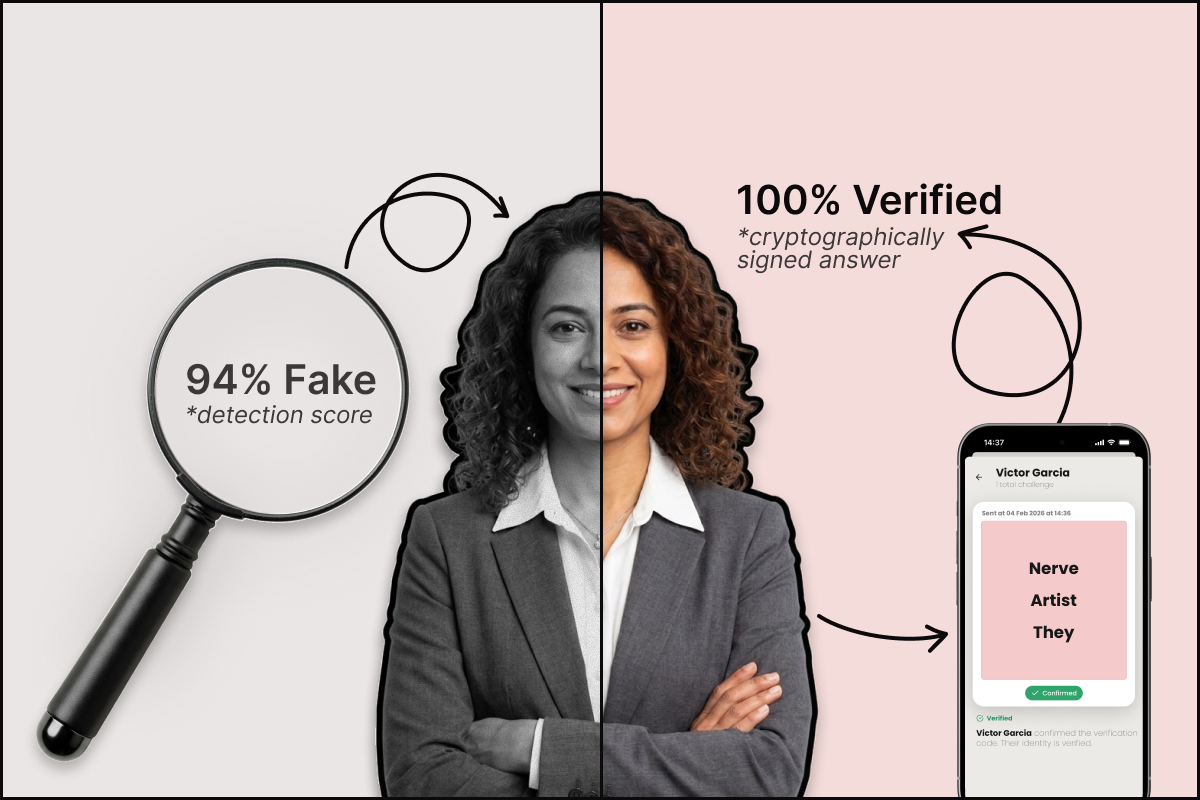
That is the gap UnDoubt is built to close. When a request arrives, whether a payment instruction, a credential reset, or access to sensitive data, UnDoubt requires both parties to verify the interaction before any action is taken. AI can clone a voice and render a face in real time, but it cannot answer a cryptographic challenge that only the real person holds. That is what makes the attack fail.
Does your team handle payments, credential resets, or sensitive approvals? Protect your highest risk workflows. Contact us at undoubt@lastingasset.com to request a demo of our enterprise solution.
Frequently Asked Questions
Can I spot an AI-generated deepfake voice in 2026?
Not reliably by ear alone. Voice cloning has advanced to the point where even trained listeners cannot consistently distinguish cloned audio from the real thing. The only dependable approach is to prove the person is really who they claim to be.
Why is fraud growing so quickly in the UK right now?
The Cifas Fraudscape 2026 report and the UK Government's Fraud Strategy 2026–2029 point to the same cause: AI tools allow criminals to run sophisticated, personalised attacks at scale for very low cost. Fraud-as-a-service platforms lower the barrier to entry further still.
What is real-time mutual verification?
A confirmation process where both parties in a digital interaction verify the legitimacy of the request before any sensitive action is taken. Unlike standard authentication, which checks credentials at login, cryptographic mutual verification addresses the specific moment a request is made, closing the window that scammers try to exploit.
Does antivirus software or multi-factor authentication stop AI-driven fraud?
These tools address different threats. Antivirus detects malicious files; MFA confirms a valid credential is being used. Neither verifies that a person is acting on a genuine request rather than a fabricated one. The Arup case demonstrates this: every technical protection was functioning correctly throughout. The fraud succeeded at the human level, not the technical one.
References
- Sumsub. Identity Fraud Report 2025–2026. Sum and Substance Ltd, 2025. https://sumsub.com/files/Sumsub_Fraud_Report_2025_2026.pdf
- Cifas. £9.4 billion stolen from UK consumers in a year. November 2025. https://www.cifas.org.uk/newsroom/9.4billion_stolenfromconsumers
- Home Office. Fraud Strategy 2026–2029: Disrupting crime, supporting economic resilience and delivering justice. HM Government, March 2026. https://assets.publishing.service.gov.uk/media/69ae77ddc78869bf8eb8a509/fraud-strategy-web.pdf
- Microsoft. Digital Defense Report 2025. Microsoft Corporation, 2025. https://cdn-dynmedia-1.microsoft.com/is/content/microsoftcorp/microsoft/msc/documents/presentations/CSR/Microsoft-Digital-Defense-Report-2025.pdf
- Group-IB. High-Tech Crime Trends Report 2026. Group-IB, 2026. https://www.group-ib.com/blog/ai-cybercrime-usecases/
- Cyber Magazine. "AI Agents Drive First Large-Scale Autonomous Cyberattack." January 2026. https://cybermagazine.com/news/ai-agents-drive-first-large-scale-autonomous-cyberattack
- World Economic Forum. "Cybercrime: Lessons learned from a $25m deepfake attack." Greig, Rob. WEF, February 2025. https://www.weforum.org/stories/2025/02/deepfake-ai-cybercrime-arup/